When it comes to Wills, don’t wing it.

September celebrates National Wills Week, a reminder to us all about the importance and necessity to create a Last Will and Testament. According to recent statistics, only 30% of South Africans have a will – which means that we have to be talking about this a lot more!

We have seen countless movies and TV series detailing the hijinx that can occur without a will. Unfortunately, in the movies all people with wills are either rich or eccentric, leaving many of us with the impression that a formal Last Will and Testament isn’t really for ordinary people.

However, it’s an essential element of a robust portfolio.

If you have loved ones and/or any possessions to your name, or children who would need to be cared for – you would greatly benefit from a professionally drafted will.

The dangers of DIY

Some may feel that it’s cheaper to simply write up their own will and keep it as general as possible so that ‘everything is covered’. The reality is that it’s generally not expensive and having sweeping generalities only complicates matters.

Legal details and regulations change regularly regarding wills. Unless it’s your job, it can be hard to understand and keep up with the constant changes. Even a small detail in a will that’s incorrect or not in line with legislation can leave your loved ones paying extra legal fees and waiting months and even years to iron out the details – or worse, left without enough income to cover monthly expenses.

Vague wording like “I leave my cars to my sons” is typical of a DIY will, and may be disputed – turning into an expensive and lengthy legal battle. What if the one car is worth R80,000 and another is worth R300,000? What if someone arrives, claiming to be a son? Words like ‘descendants’, ‘my business’ or ‘personal items’ are also legally vague, pitfalls and loopholes are hard to spot if you’re not a trained lawyer.

Legal terminology like “bequest of the residue” are terms you may have never heard of and would certainly not put in your Last Will and Testament – all the more reason to hire a professional and save your family the additional heartache and stress later.

Microsavings: when a little goes a long way

There is a lot of good financial advice out there which goes something like this: ‘you know that money you don’t use every month? Well, take R50,000 and invest it in X now, and you’’ be happy later.’

Sound familiar?

The problem with this advice is that it’s incredibly alienating for the other 92 percent of people out there who a) don’t have money left over at the end of the month and b) would laugh and rub their hands with glee like Scrooge if 50,000 unaccounted-for rands came calling. That’s not real life, for the average Joe. So, where does one find financial advice for people without the silver spoon?

This blog post is for you. It’s about a term which may well answer many of your problems: microsaving.

What is microsaving?

Just like the name says, this is putting small bits of money aside. Think of it as the digital equivalent of what your grandparents did with a kitty back in the day, dropping spare coins regularly.

Microsaving is about taking whatever amount of money is small and unnoticeable to you and tucking that away in a place you can’t spend it. So, for instance, you buy a weekly wrap at work that costs R35 and so your microsaving method of choice squirrels away the R5 into a savings pocket, separate account or another wealth preservation vehicle like your RA. If you know that you regularly come out at the end of the month with about R900 aside for your daughter’s ballet things, which often comes to R800 actually, microsavings pockets that extra hundred.

These are by no means big amounts and – caution – no microsaving tool will get you the returns that investing R50,000 in a reputable vehicle would, but they are certainly better than not using microsavings. Here’s why.

Mindfulness matters

For most of the people that can’t afford to save or invest traditionally, it’s not entirely true that they don’t have one single spare cent unaccounted for each month. It’s more a mindfulness issue. Money coming in like salaries are given vague budgets at the beginning of the month and then, like a black hole, it juts vanishes into a million little things and unforeseen expenses. Do you have an emergency fund each month? Do you estimate and account for how much you spend tipping car guards and paying for parking? And because savings and investing are often the last in line, the if-I-have-enough amounts, by the time their turn rolls around there is no money to save or invest.

A microsaving app, banking feature or some other investment vehicle (Liberty’s Stash and FNB’s Bank Your Change are quite good) takes into account this lack of mindfulness by taking off that R5 from the wrap, R100 from the ballet recitals money, knowing you won’t notice. And then you have something like R400 at the end of each month saved away – certainly not the R2000 you were hoping to save, but better than the zero you were headed for.

From microsaving to microinvesting

Of course, it’s not just saving that this approach is good for. Instead of sending your loose change into a savings pocket, what about into an investment vehicle? Or your retirement fund? Or the trust you as a couple set up for the kids’ university fund? The possibilities are endless and, especially when coupled with intentional saving and investment of larger sums, microinvesting can be powerful.

Sometimes it pays big to go small…

Five awesome things about women investors

It’s Women’s Month, and we’ve been thinking lately about all the ways in which women are wonderful in matters of money.

Women as investors don’t get praised often enough – there’s been an unfortunate stereotype in the past that keeps finances in ‘man territory’. Today, we’d like to honour the ladies in our stock markets and on our shareholders’ boards and count the ways in which they rock and the things male investors can learn from them.

They consistently outperform on returns by being faithful

A Financial Times article cited two studies a couple of months ago. It had this to say:
“Warwick Business School conducted a study of 2,800 UK men and women investing with Barclays’ Smart Investor, tracking their performance over three years. Not only did the women that were examined outperform the FTSE 100 over the time period, they also achieved better returns. The men in Warwick’s study managed an average annual return 0.14 per cent higher than the FTSE 100, but women outperformed the benchmark by 1.94 per cent, beating men by 1.8 percentage points. A separate study by Hargreaves Lansdown also found women investors returning on average 0.81 per cent more than men over a three-year period.”

The reason for this, according to spokesperson for insurer Liberty Daphne Rampersad in an article this month, is that women tend to stick with investments, “getting higher returns over the long term, while many male clients choose to switch when markets go south”.

Those that do go against the grain

Despite these impressive results, the woman investor is certainly the minority. The same FT article cited earlier stated that “55 percent of women said they had never held an investment, compared to 37 percent of men. Just 21 per cent of women said they held a current investment, compared to 35 percent of men” in the UK, famously less sexist than South Africa.

Many reasons have been attributed to this, from a dearth in financial advisers to older generation South African men teaching their sons about investing but not their daughters.

Also, where are the women’s role models? Despite giants of the industry being female – JSE CEO Nicky Newton-King comes to mind – there are no articles on Warren Buffett-type female investors, here or abroad. That makes the women who do invest that much more impressive.

They stick with what they know – and that’s a good thing

“Men tend to favour new, untested shares, whereas women will stick with tried-and-trusted, recognisable names”, says HSBC private bank in an article on its website. Unsurprisingly, this also often results in women getting more tried-and-trusted, recognisable results than male investors, thanks to their tendency to stick with a ‘sure thing’.

… Despite ‘bucketing prejudice’

That being said, women are often stereotyped unfavourably by asset managers and their portfolio managers in general. This is thanks to the notion of ‘risk profiles’ – somewhat outdated now in developed markets yet still used widely in South Africa. Due to women being seen as more ‘risk averse’ than men, they will be given investment options with lower returns because, well, higher risk means higher potential returns.

This is how it often goes. A woman will go in/phone in to set up a new investment. The manager, often male, will give her a risk profile assessment rather than ask her what her goals are and what assets she would prefer. Instead of saying ‘if you want X returns, you can only get that with equities, although you stand to lose more there too’, he will more often ask ‘how much are you comfortable with losing per annum?’ This is called shortfall-based rather than goals-based. Most women, baffled, will reply that obviously they would like to lose as little as possible. Thus, women are consistently given scores of less risk appetite than men, due to both the phrasing of the questions and the way they are automatically bucketed for being female. Research has shown that less women invest in equities is the reason given – but it has been socially acceptable for women to invest for less time than men, and women are given equities by default less often.

It is a tiring, unknown prejudice which shows women’s greater returns and their involvement in equities at all as even more impressive.

And they get impressive financial gains despite more obstacles than men

Apart from all their obstacles from within the financial landscape, there are numerous other things standing in the way of financial success for women. Women are given higher insurance premiums and less life cover than men consistently, despite being labelled ‘more risk averse’ than men, and receive on average 28 percent less for salaries than men doing the same job in South Africa.

More than 60 percent of South Africa’s households are run by single mothers paying for everything, according to Statistics South Africa, while less than four percent are run similarly by single men.

Higher returns and better staying power despite more obstacles and often less money to work with? To paraphrase the 1955 Women’s March anthem, a woman investor is solid as a rock. You go, girls.

Don’t let market cycles catch you out

Source: Investopedia

If there were a set of commandments for investing, the first commandment may well be this: know your seasons.

Just like a surfer or fisherman know the tides of their favourite spots, prudent investors know the market cycles.

“The problem is that most investors and traders either fail to recognize that markets are cyclical or forget to expect the end of the current market phase,” says Investopedia. Many investors will come up with a strategy, and it may be a very good one, then with enthusiasm rush out into the marketplace and expect to impose their vision on the market or, in their excitement, misinterpret the signs.

This is like rushing out into a thunderstorm without an umbrella in a T-shirt, because you feel like sunshine. We all need to obey what the climate and environment is doing. A good investor is very much like a farmer, knowing that there is a time to sow and to reap, to keep store for lean months and times to feast as well.

The four seasons

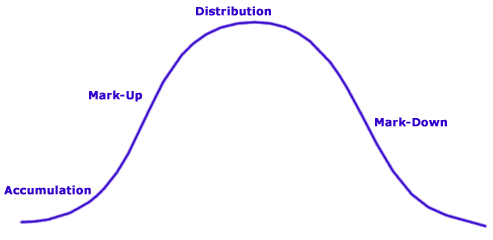
Just like any other rhythm or cadence, markets tend to begin low, climb, reach a certain high point and then fall until a certain low point. Then the cycle begins again.

The four phases are generally referred to as accumulation, mark-up, distribution and mark-down in the financial industry. Allocation is the beginning of a new cycle, when prices are low and savvy buyers are buying. As things in the market settle and rally, the prices rise and this is mark-up. At the investment’s peak, when it has become the most valued and expensive it’s going to get, that’s called distribution because the savvy sell now. Those who don’t sell have to deal with mark-down, the fall from grace, when the investment loses its value as the cycle descends to begin anew and ride the next mark-up wave.


Source: Investopedia

If they sound a bit like shopping around Christmas in fancy department stores, you’re right – stocks are a product and, just like any other product, have a marked-up price and a discount price. It’s wisdom to buy it ‘on sale’, wait until it’s in demand and then sell it for a higher price than you bought it for before it devalues as the next new thing comes in.

Know your animals, too

Then there’s also the global sentiment of the market: bullish or bearish, hawkish or dovish and for what reason. These are directly linked to the four phases. Currently, America is in a fragile, yet still-running, bull market – the longest bull market in history. Many a betting man would’ve lost his shirt by predicting, reasonably, that it would have ended a long time ago. But that’s how markets are – and we must be cognisant of them. It would be just as foolish to not take these into account as it would be to build your entire investment strategy around them.

A man for all seasons

There is a reason for the phrase ‘unpredictable as weather’, which should also be ‘unpredictable as markets’ – it can be famously hard to predict the exact right moment when an investment will reach its peak value, will start to decline or appreciate. The cycle is a law unto itself at times, just like climate patterns and weather – there are rules, but no one knows when there’ll be an exception.

If anything, the cyclical nature of all markets shows the need for good advice. Lean and fat times come and go, but your future security should not depend on it but rather get richer and mature with the seasons, just like you.

The seven habits of cyber secure people

It’s not for nothing that cyber crime and hacking was considered 2019’s number one “major risk” by the world’s largest insurer, Allianz, in their latest Risk Barometer Survey. These days, it’s not if the security of your electronic identity and assets will be tried by a criminal, it’s when.

While no one is completely guaranteed safe from a cyber attack, these seven habits will mean that you’ll be a harder target than someone else and so, by default, cyber secure.

1. Cyber secure people never use free WiFi
South African speaker and social media legal expert named Emma Sadleir has a wonderful saying: ‘when something is free, you are the product.’ Don’t ever use a network that you don’t need a password to log onto, or even one that’s free. Hackers often either set up their own (very legimate-seeming) hotspots or sit in an existing one waiting for prey.

2. Cyber secure people use two-bit encryption
The more encryption you can use, the better. People who are secure online use systems where they will be told of logging on to banking and all banking steps via email or SMS and get One Time PINS (OTPs) for everything. OTPs make use of two-bit encryption and if you don’t have the code, you can’t complete the transaction. This sort of security is far harder for a hacker to hack and so, usually, they won’t go near a bank account with two-bit encryption.

3. Cyber secure people never, ever, ever give someone else their login details
There is a chilling tale of a savvy business woman who was called by her ‘bank’. They had her ID number, they had her card number. They just needed her PIN, please. They even had a call-back mechanism which directed her to her bank’s authentic call centre. She almost fell for it. Here’s the thing – no bank will ever, ever ever EVER ask you to type in your PIN, say your PIN or write your PIN down. The same goes for your username and password. It doesn’t matter if you’re in the bank itself. Never write down, say or otherwise disclose those three things.

4. Passwords are never easily guessable with the cyber secure
Anything that could be guessed at by someone who isn’t your spouse or mother isn’t safe for a password or PIN, including your birthday, anniversary, year you were born, address or ‘1234’. That goes for your security questions that the bank asks you too. Don’t just put your high school or first job – someone could stalk you on Facebook and find that out. In fact, criminals use this trick all the time.

5. Cyber secure people have varying, different passwords
This one, many of us are guilty of. Not many of us have unsecure passwords like our birth dates, 1234 or the word ‘password’ anymore. We have one strong and hard-to-guess one with upper and lowercase letters, numbers and symbols in it – but only one. It’s so much easier to just remember one password, isn’t it? But cyber criminals know that too, and so they know that they just need to get your details off one not-so-secure site and then it’s open sesame for everything else. So, use different passwords – completely different.

6. Cyber secure people are wary of personal info on groups
Those not-too-safe sites we just mentioned? Well, few are as unsafe as groups on WhatsApp, Facebook and Telegram. Especially not those really large ones where you don’t know each individual on there very well. We don’t care if it’s the church group or the over 70 year-olds’ group – don’t send any personal info including bank details and your address. You never know who is part of the group and looking for information.

7. … Or Gmail
This may come as a shock, but some cyber experts consider Gmail accounts easily hacked and not too safe. The extreme popularity of them might be one reason but, just to be safe, do not send sensitive information over Gmail if you can help it.

Remember, we can’t be 100% secure online as new hacking techniques are being unceasingly developed – but we can be mindful of our online security. If you are ever in doubt, update your passwords.

5 ways to keep you and your money warm this winter

It’s a cold world out there this June. As the thermometer temperature drops, the price of fuel and cost of living keep rising… but it’s not all doom and gloom.

Here are five ways to manage your finances a little more wisely and warmly:

Drop the bouquet

The average South African home is way too glued to the TV for their physical health – and financial health too. If you love your screen time, drop your exorbitant DSTV bouquet and look at Netflix or Showmax (or another provider) and honestly stack up the costs side by side. You’ll never go back to DSTV again. If you like to watch live sport, consider watching these matches at friends houses, or at your local pub.

Phone it in

Remember your old flip phone from years ago – the one that you (and everyone else) thought was impossibly cool? Well, that’s how all phones are going to look someday. As part of your winter finance warming, review your cellphone contract – but don’t upgrade. If there’s nothing badly wrong with your phone and it works okay, do not get a new one, no matter how shiny and awesome that new one is. One of the most powerful first steps of red-hot finances is to stop changing your phone every 18 months.

Get car smart

The ever-increasing fuel price is one of South Africans’ biggest bugbears – and expenses. Get smiles for miles when you become more creative with your commute or other transport needs, by setting up a carpool with, for example, work colleagues or parents in your area with children at the same school as yours.

Another thing to do is check with your bank at which fuel stations you can get banking points, such as eBucks or Discovery, when filling up. Then only go to those stations if you can help it, to get a marginal amount back a month. Hey, every bit helps…

Insure you get the best

One of the first things that go out of the window when budgets get tight is the so-called ‘grudge purchases’ – chief among those, insurance. But in this case, it really is penny wise and pound foolish to drop your short term insurance when the purse-strings are pulling tighter. Plenty of families have gone from wealthy, or even comfortable, to dire straits because they cancelled their insurance and then misfortune struck.

Most South Africans appreciate the value of car insurance, considering our road death statistics and the colourful manoeuvres taxi drivers pull on a daily basis, but don’t value other forms of short-term insurance.

Are you covered for household burglaries, technical problems with your phone, a handbag getting stolen, losing your motorbike keys? All these things are vital, so in reality, you cannot afford not to be insured.

However, that doesn’t mean all insurers are created equal, or the same price. Ascertain what your insurance needs are and which option best covers them and dig into the best deals you can get on insurance.

Just because you can’t afford not to have it doesn’t mean paying more than you should.

Whatever you do, don’t stop

If insurance is a grudge purchase, this next one isn’t a purchase at all – and often gets pushed to the back of the priority line until it’s much, much too late. Do not, we repeat, do not try to help out your budget by not saving for retirement. The thing with retirement is this: there will never be a better time. That’s because of compound interest – you’ll never get a better return on money invested at a later date, even far larger sums of money, than a small amount invested now. So, don’t skimp on modest sums for retirement now, and you won’t have to skimp on everything for up to twenty-five or more years of your life. Seriously.

To keep it simple, here’s a motto you can use: don’t stop saving unless you’re retired and, if you are already retired, don’t stop saving.

Keep these things in mind and you’ll have a financially toasty winter season. Enjoy!

Taking an interest in interest rate risk

Education around the basics of wealth creation and preservation is like a good, solid diet packed with healthy food staples, it can help you enjoy healthy finances for years and create a strong foundation for building your future.

Bonds are a healthy part of any portfolio or ‘diet’, and most people think they understand them. Today, we want to talk about an aspect of investing in bonds most people misunderstand or simply don’t know about – interest rate risk.

In today’s highly uncertain market, bonds remain an attractive option. Not subject to having the sudden market-related dips (or spokes) that equities do, it’s a lower risk option for preserving or growing your money in most environments.

Sounds great, right? Potentially.

Most bonds pay a fixed rate of interest over a defined period of time.

What many investors don’t understand about bonds is that the rate is set according to prevailing market interest rates at the time of issuing the bond, but the market interest rates that occur afterwards during the period of the bond may not be even remotely similar to the ‘weather conditions’ when you first took out the bond.

What this means for your money is that, should interest rates rise, your bond’s value will lessen. Should interest rates fall, the reverse will happen – your bond is now worth more. Because this is directly related to inflation (interest rates rising are usually due to CPI itself rising above what’s been predicted for it), a good way to understand this is inflation. If inflation increases, even though you have the same notes and coins in your wallet, that money is effectively worth less. If inflation decreases, slowly your money will be worth more in relation to the rest of the market (price of eggs etc.). It is not the notes or rands themselves that have changed if the inflation rises, it’s the market.

This is interest rate risk, and it’s a vital element which affects how much return you’ll get once a bond matures.

It is seldom that we truly know what is going to happen to the market in the next two to three years with absolute certainty, but in the case of interest rate risk, it seems that we do. South Africa will be hiking rates for the foreseeable future, as announced at the end of last year when the Reserve Bank’s Monetary Policy Committee (MPC) said it would raise the repurchase rate quite significantly to 6.75% per year as of November 2018.

What does this mean for our bonds? Well, if you look at the above in SA in isolation, it means that a bond’s value will lessen if interest rates rise (which they have) and will continue to do so if interest rates continue to climb (which it looks like they will).

A word of warning – any investment in any form should be underpinned by knowledge. Choosing to put money into a bond of any kind is no exception. Taking interest rate risk by investing in a certain bond without knowing every aspect inside and out is like getting onto a horse and expecting to ride it when you don’t know how a horse moves.

However, if you only ever invest in things you already understand, where will that leave you? Your money may grow, but your own horizons and understanding won’t.

Consider this a call to adventure – not to invest in bonds necessarily, but rather for us to chat about things you don’t fully understand, perhaps interest rate risk being one thing, and start an exciting new chapter in your financial awareness and confidence!

Betting on cars – how to invest in motor innovation without getting a flat

“Never look back unless you are planning to go that way,” Henry David Thoreau once said. Investing in the future is an exciting prospect, but a daunting one as well. And what could be more of a ride than investing in motor vehicles?

But the road can be a bumpy one, even if it is a fast ride, so prudence is paramount when investing in all things motor.

Here are four of the biggest draws for investing in the future of cars:

Electric

According to Allan Gray, Bloomberg forecasts that EV sales will increase from a record of 1.1 million in 2017 to 11 million in 2025 and reach 30 million by 2030. Sounds great, right?

Not so fast – electric vehicles are, like most new technologies, still prohibitively expensive to make and not available to the mass market yet. This means that even if electric cars were to go mainstream, they would be making a loss for investors for some years to come. Except perhaps for Tesla, but that is a big perhaps.

Also, in developing nations like South Africa, the infrastructure just isn’t ready – the Champs-Elysées may have plug points for electric cars, but Jan Smuts and Chapman’s Peak certainly don’t.

Hybrid

This is the other major problem with investing in all things electric – hybrid cars from mainstream motor companies like Jaguar and Mercedes mean far lower fuel emissions comparative to electric cars, yet at a fraction of electric cars’ price.

“…the consumer appeal for electric cars is based on their lower carbon emissions and lower running costs – something that hybrid cars (that are propelled by a petrol or diesel engine with an electric motor) also offer [and] traditional automakers are well placed to compete in this segment,” says Allan Gray’s investment analyst Sibabalwe Kasi.

Self-driving

The most talked-about and Asimov-like motor innovation of the moment is driverless vehicles. It’s arguably one of the more difficult trends to take seriously for those in developing nations who have only ever seen them in Sci-Fi movies, but it could be a real meal ticket for early bird investors if done right.

“The autonomous vehicle (AV) market is going to take years to mature, but a lot of progress is already being made — and investors should start taking notice of its growth now. In 2040, an estimated 33 million driverless vehicles will be sold annually, and Intel and Strategy Analytics predict that self-driving vehicles and their services will create a $7 trillion industry by 2050,” says respected US finance site The Motley Fool.

However, patience is the name of the game here. “While all of these companies have lots of potential in the AV space, it’s going to take years for them to begin seeing sizable contributions to their bottom lines. That doesn’t mean that self-driving cars aren’t coming or that they won’t be transformative when they do; it just means that investors should temper their expectations as this new market unfold,” The Motley Fool concludes.

Car sharing

Another potential avenue for investment isn’t in cars themselves at all, but in the companies behind the ongoing ride sharing revolution. Big name companies like Daimler and BMW are betting on a future in which almost no one in urban spaces will own a car soon – and it’s a compelling gamble.

In an ever more environmentally conscious world with diminishing fossil fuel resources and more strict emission laws, owning your own car may not be normal forever. This is especially true in a future where self-driving cars dominate the roads. If your car could drive itself to you to fetch you from work, why should you pay a larger sum to have that car ‘service’ only you, when you could pay a fraction of the cost and still be picked up whenever you wanted, like your own driverless Uber?

So, which choice is best? It’s up to you, you’re the driver of your own investment, er, vehicles… Just ensure you have an advisor who knows their stuff in the passenger seat.

The four numbers of retirement – and why they aren’t enough

‘It’s my life, it’s now or never. I ain’t gonna live forever…’ The famous Bon Jovi words could well be used to describe retirement – and saving for it.

Most people don’t know where to start when contemplating something as big and hectic as retiring in decades’ time, but there are ample titbits of conventional wisdom from the financial planning industry. Let’s take a look at some, and their pitfalls.

The most well-known number: 65

The age ‘65’ is the one we all see on the calculation spreadsheets and articles about retirement. Retirement annuity and pension fund products are generally designed to be withdrawn when the individual turns 65. You may well be forgiven for thinking that everyone who retires from work does so the minute they blow out the candles on that 65th cake – but you’d be wrong.

To say ‘I am going to retire at 65 no matter what’ is to overlook and discount the type of work you do, your health and the future of healthcare as we know it. A professional sportsman, for example, may need to retire at just 35, whilst an author could comfortably go on working until 80.

Once you hit 65 years old, you may be having so much fun that you may not want to retire yet, or you may contract a critical illness in your fifties which means you cannot work anymore, a full decade earlier than planned. There’s also the pesky matter of longevity. For years, science and healthcare has advanced and people are living longer and longer lives, yet that stubborn ‘65’ has stayed the same.

All these things are variables that most do not take into account when they insist they will retire at 65 – and we all know that when you fail to factor some of the variables into your calculations, things just don’t add up.

Another number: 75

No, this is not the new, older age to retire at – this, according to the financial planning industry, is the amount of your current final income which you will require at the age of retirement.

It’s hard not to see the problem with this one. A student earning ten thousand a month coming to a financial advisor, for example, may be told they’ll require 75 percent of their normal income in retirement. But that rigid number fails to factor in the fact that that same student will need triple or quadruple his current monthly salary in just 12 years’ time when he’s married, has bought a house and is paying for two kids’ schooling. At that point, the calculation of 75 percent may well be correct, but not always. Either way, it serves as a useful starting point when trying to visualise your future.

The number for right now: 15

Of the few that do save for retirement in South Africa, most save 10 percent or less of their salary towards retirement. Gross salary. If you earn fifty thousand a month, for example, and put away five grand towards retirement each month without fail, you may feel pretty good about yourself A lot of people don’t put away anything, after all. But conventional wisdom states you should save 15 percent of your monthly salary towards retirement.

What is important to note is that you are an individual, with unique life circumstances, and numbers are often just that – numbers. An abstract figure of ‘15 percent’ may not take into account your life situation at all – 15 percent isn’t going to be enough to buy a yacht and retire at 50 unless your monthly salary rivals Bill Gates’. 15 percent may just not be doable for a struggling single parent of four kids who is trying to put food on the table. It’s all relative to your personal situation.

The number for once you’ve retired: 5

Let’s assumed that you don’t want to financially cripple your children by forcing them to take you in once you retire. Let’s assume you want to live reasonably comfortable, independently, for a good twenty years in retirement. The number for you now is five – financial professionals dictate that you will draw five percent of your total amount saved for retirement every year of retirement.

What they fail to mention is that five percent of, say, Jeff Bezos’ retirement savings, will look very different to your total retirement savings.

Also, what about inflation? Inflation has been rising at a steady and relentless rate for the past few years showing no signs of slowing down, yet the average balanced fund in SA has grown just five percent or less over the last five years. If you dutifully save your 15 percent each month, then later only draw five percent of your savings a year and yet CPI has been increasing by six percent year on year, that’s not going to work out that well. Even though you did exactly what the numbers told you to.

There is no real formula

What all the above illustrates is that using abstract generalisations for individuals living real lives just doesn’t work. Numbers like 65, 15 and 75 are a helpful starting point, but are designed to be just a start before you individualise beyond that according to your personal financial needs and future.

The best way to think of the numbers above is to think of them as a minimum, not as a goal. A lot can go wrong even if you do save 15 percent of your income to live off of 75 percent from the age of 65 years.

So start here, but don’t finish with the numbers. They could never define you as a person, so don’t let them define your future.

Delicious savings – how to eat for a week on four meals

With tough economic times all around, a lot of us are trying to cut unnecessary expenses. Be that as it may, we still need to eat and feed our families. Yet who has the time to play chef and work a fulltime job? And who wants to eat mediocre meals just because the economy is in a slump?

Enter the power of three – how to ensure meals for a week with minimum effort. It’s all about selecting three dishes that are low maintenance to cook, able to be made in large quantities and also be to be frozen and reheated… yet are still big on taste. One great meaty supper that transforms into two days’ school sandwiches as well, one that can be reinvented into finger food tapas on the third day and one versatile enough to be reinvented into a whole other dish come day five.

And all with room enough for leftovers.

Sound cost-effective? We’ve collected four inexpensive meal ideas that meet all these standards, leaving your tummy satisfied and your wallet untraumatized upon your next grocery jaunt.

Meal 1: Roast chicken, veggies and rice

A classic family meal, the decent-sized roast chicken easily feeds four people. Make extra and use leftover white meat for chicken mayonnaise sandwiches for school and chicken salad for the adults. Use the leftover rice and bits with skin to make a fantastic, Asian-inspired twice-fried rice and sweet, sticky chicken with the help of simple fridge staples like chutney or balsamic vinegar and soy sauce. Rice, if sealed, is superb the next day – just like pasta or slap chips, so go wild. Save the carcass and you can even make soup from it, if you’re so inclined.

Meal 2: Brisket and boiled potatoes

If you want something a little more special during the week, look no further than the all-star cheap meat cut classic, the brisket. Have straight-up brisket with boiled potatoes on day one, reinvent the leftover on day two with a sticky glaze and turn leftover potatoes into creamy mash and then take any last bits and turn them into a stew. Delicious!

Meal 3: Pulled pork and veggies

Pork is still cheaper than other meats like steak or salmon, and a good pulled pork recipe will mean minimal handiwork – you just leave it in the oven for a few hours. With vegetables, it’s a decently healthy meal with one serious upside – pulled pork has got to be one of the most versatile meats on the planet. It can be reinvented into tacos, salads, sandwiches and even scrambled eggs. Unlike other practical bulk meals, it’s polished enough to serve to guests as well.

Meal 4: Lamb stew

Who doesn’t love a great lamb stew? Because it’s stew, you can buy a fairly cheap cut of lamb in generous quantities at a decent price and can make tons of stew easily. The ‘easy’ part is the best part, because lamb stew in a slow cooker means very little work. You fry up the meat and chop veggies and simply leave it for eight hours while you go to work. Freeze half for an instant dish that is hearty, healthy and super quick to reheat.

Well, what are you waiting for? Get cooking!