TO INVEST OR DISINVEST…THAT SEEMS TO BE THE QUESTION

Fund managers often tell us how they try and personalise their funds as this helps them when making certain decisions. They would often think of their grandparents or parents or close family friend and consider how decisions will impact them if they are the holder of the fund. So, when writing this article, we were faced with the same questions: ‘How are our parents, grandparents or siblings dealing with this sudden market crash?’ And, most important: ‘How are our clients perceiving the economic climate?’

The starting point is to provide some perspective as to what exactly happened. It is by pure chance that the coronavirus and the oil price crash overlapped and as these events coincided, it inflated the economic crisis. Furthermore, investors started to panic, and not only did we see a bulk buying of durable goods at our supermarkets, but also a panic sell-off in the stock markets.

Yes, it makes sense for a company like Sasol, which still earns a fair chunk of their income from oil, to crash when the oil price falls. Sasol has been busy with expensive projects in the USA and have incurred large amounts of debt over the last few years. Their oil business requires the oil price to trade at $35 a barrel or more in order to operate and repay debt.

There are typically two things that drive markets: fundamentals and sentiment.

With the frenzy of a global pandemic; factories closing; panic buying; fear of the unknown; small businesses forced to close temporarily, and travel bans, sentiment started to drive and fuel the sell-off we saw in the markets over the last few weeks. Adding to this, large economies started to see their central banks cut interest rates in order to assist with some money being pumped into the system. Normally this can spark a rally in the stock market, but markets initially didn’t respond positively to this news and interpreted these extreme measures from central banks as an indication that things are worse than expected. This pushed the markets down even further.

So, knowing some of the reasons behind what has been driving market negativity, investors are now faced with a very difficult decision: Do I disinvest or stay put?

The answer to this question isn’t as simple as you’d hope. You see, each investor is invested for a different life goal and for a different investment period and it will thus depend on many variables. It therefore isn’t a simple yes or no.

In a perfect world it would be great to know the following before we make a decision:

  1. Could markets go further down?
  2. When will markets recover?
  3. Is now a good time to cut my losses?

There are so many variables in the market that it is impossible to answer any of these questions without some sort of caveat or fine print.

If you were planning to retire:

Well, maybe give this a second thought. Unless you’ve reached retirement age and are forced to do so, you could reconsider and postpone your retirement. Many pension funds had exposure to the likes of Sasol and other shares, and your retirement capital could be less. Given that the bottom of this market crash is uncertain, postponing retirement could provide an opportunity for pension funds to recover, increasing the capital available with which to buy a pension income.

You’ve recently retired:

As wealth planners we have seen previous market corrections and more harsh market crashes. This is also why we draft investment plans for our clients first and trust they will stay the course and stick to the plan. As wealth planners we also believe in diversifying clients’ portfolios. As an investor you can opt to invest in many asset classes such as money markets, credit instruments, equities, property and bonds. When we look at the returns of these asset classes since 1 January to 17 March 2020, it shows that not all asset classes have reacted similarly and when blending different asset classes, you could potentially reduce the severity of a market crash on your portfolio.

What we have often seen is that once the panic dissipates, markets tend to recover quickly and investors who switched to safe-haven assets incur permanent losses on their portfolios that are seldom recovered. They would have been better off had they stayed in the market regardless of their anxiety.

You are fully invested:

If you were fully invested in equities, then switching to cash, as mentioned above, could mean permanently eroding the capital. Again, if you had a crystal ball and could say with absolute surety that the markets would go to 0, then I would agree that you cut your losses and try to save the bit you have left. However, if you have no surety as to where the bottom of this crash is, you also have no means of timing the recovery. Evidence shows that making no changes are often more effective than reacting on the sentiment and market noise. Answering questions such as: ‘Should I cut my losses?’, ‘Can it get worse?’ and ‘When will things get better?’, lead to emotionally driven decisions. It is often useful to learn from history and we do not have to look too far in the past to get such an example. In the 2008 great financial crisis, if you invested R100 in the JSE on 1 January 2007 and disinvested your money 31 December 2008, you would have cashed out R91.50. If you then decided to reinvest this back into the market on, let’s say, on 1 June 2009, your value as at 31 December 2019 would have been R311.80. However, if you didn’t disinvest and stayed put right through until 31 December 2019, your end value would have been R336.60. There might have been perfect market timers whose results would differ, but the calculation illustrates that missing the best days in the market or timing it just slightly wrong could have a worse outcome than staying invested.

You have money to invest:

You are very fortunate to be in this position. The world, as incredibly chaotic as it may seem, is offering you so much potential in terms of investments opportunities. For the first time we are seeing the shares of large companies offering good value. Although novice investors should take note that not all things that are cheap have value, there are good quality companies that present buying opportunities that haven’t been seen in a long time.

Bonds could also unlock great value, as the current valuations are attractive. When bond yields are high, their prices are low. This means that if you buy bonds at the current levels, you are buying a good interest income for years to come. It also presents the opportunity that a capital gain can be earned, as it is expected in times like these that interest rates will be reduced. As interest rates come down, bond prices tend to increase, leading to capital appreciation. Yields have recently picked up to levels last seen in 2008, and this could be a great opportunity for investors.

It is thus important to evaluate your own situation as an investor. Try to avoid following the herd. Consider what news really impacts you. When you see the headlines reading ‘JSE lost 22% since the start of the year’, it doesn’t mean every equity fund lost this amount and it doesn’t necessarily mean your wealth is down with 22%. Fund managers also diversify, and they make use of very complex instruments such as hedges to protect against such losses. As an example, whilst the JSE retracted by 22% over the last few months, some general equity funds lost only 7%.

Consider the silver lining as well. As interest rates are being cut, debt repayment becomes more affordable, and while Sasol (and most of the analysts and wealth planners out there) could not have foreseen the sudden price war of oil, this too brings some relief as petrol prices will come down in April. This could assist in reducing inflation in months to come.

The key takeaway from this article is to always analyse your own situation before reacting on the market noise and market news.

  1. Consider your time horizon. If you are a longer-term investor then avoid being short sighted during this time.
  2. Don’t get wrapped up in the bad news. Distinguish between noise and news.
  3. Make sure you understand the numbers.
  4. Stay the course if you have an investment plan. Your investment plan is tailored to your needs, wants, goals and time horizon.
  5. Don’t try and time the market. If you are planning to invest for a goal or a certain investment horizon, now is as good a time as ever. Time in the market is more important than timing the market.
  6. Diversify your portfolio.
  7. Don’t be fooled now in these panic times by schemes promising to deliver double digit guarantees. Remember that during these times we meet the bitcoins, Sharemax and fixed deposit businesses that disappear as quickly as they appear (with your hard-earned money).

As a final thought, it is best to consider that we live in different times and not all pandemics end the same way. Not all pandemics are equal, and some last longer or are more devastating. We should also note not all economic crises are the same and that even the recovery of the markets might take longer or shorter, and it might come just as quick as the sudden shocks.

What you could potentially do as an investor (private, professional or institutional), is consider your way of doing: Perhaps work longer, consider alternative means of generating income, review your budget, and finally, while the world is facing a global lockdown, be safe and considerate of your neighbour.

Keep a social distance and remain calm.

Investing masterclass: Four tips for the long game

When it comes to coffee-shop conversations, little is said about the long game in the investment space – it’s often about which asset manager did well this year, what outperformed everything else in the last quarter… etc.

But, if you’re an investor, chances are high that you’re saving for future events that have a five-year-plus event-horizon (as we all should!).

Here are four thoughts for investors looking to improve their long-term results. If you’re feeling shaky in your investment behaviour, these will certainly help to master your long game.

Tip 1: The past does not predict the future

It’s the most common mistake in the book, so entrenched in investment culture that even the most seasoned among us fall into this trap. It’s the thinking that ‘X Asset Managers beat the index by nine percent last year so they’re the best bet this year’. X Asset Managers in turn, who may not even have the same actual people on board anymore or may have undergone a whole host of other changes to the ‘magic formula’, adjust their fees up accordingly.

There are plenty of problems with this. One is that, if you keep a close eye on the top performers, you’ll notice that the same managers are almost never ever in the top spot consecutively. This means that if you doggedly follow the best performers, you’re going to switch funds every year, decimating your return potential.

Secondly, as we’re well aware of in other spheres of life but conveniently forget in investing, our global future and rate of change in the next decade will be different to anything in the last century.
“But surely that won’t change the actual nature of the markets,” some may say.

Yes, it can. We’ve already had what should be an impossibly long bullish cycle and more black swan events in a decade than ever before. We need to beware.


Tip 2: Switching frequently is usually a bad idea

Most of us know the two cardinal sins of investing: not preserving when switching jobs and chopping and changing funds or managers too often.

But what about when a crisis hits? Switching from other assets into cash may be just as harmful.

When the going gets tough, generally, most investors go for cash. And there is some wisdom to this – cash is a great low-risk asset that generally does well in times of crisis and is therefore event-horizon specific. But taking money out of, say, equities, and exchanging it into cash is often a case of winning the battle but losing the war.

The thinking is that ‘if I get this out of equities before equities experiences a downturn and put it into cash, then switch it back, I’ll save the amount I would have lost.’ This gambles the losses from switching with the gains made from avoiding a loss when markets turn south. The problem with this is that most (who are not whizz asset managers by profession) will get the timing wrong. This leaves you with two losses when, longer term, simply staying put would have made more sense.


Tip 3: Care about shares

There are widely held misconceptions about different asset classes, many of which are harmful for players of the long game in investment. One of the most common is that equities are risky while bonds are safe, and cash is the safest of all. And a short-term glance at the market may seem to confirm this belief, however the opposite is true when it comes to longer-term strategies.

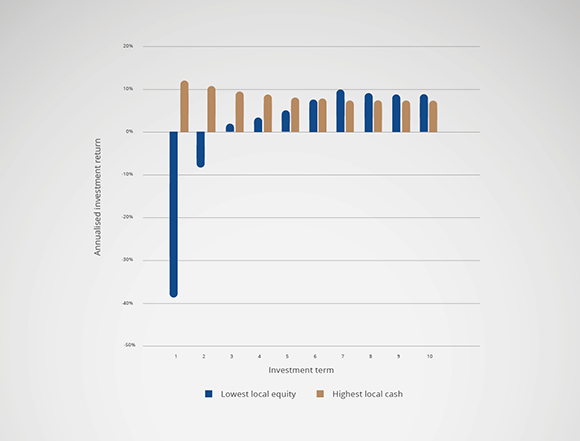
Think of investing in cash (a.k.a. the money market) as the investors’ equivalent of stuffing your cash under the mattress. If your aim is to not lose any money – then you’re in luck. That money may be safe from being lost short-term. But it’s also not growing as much as it could, while other things like CPI are making it worth less and less. Equities, on the other hand, have shown to give back the bigger returns compared with cash longer term, even though short-term your chances of making losses are higher.

The lowest annualised local equity returns versus the highest annualised local cash returns over different investment terms

Based on historical returns data since 31 November 2007. Source: Morningstar to end of December 2018


Tip 4: You get what you pay for

One of the biggest ‘grudge purchases’ of the financial world, after insurance, is the fees associated with funds. Some charge two or three percent, others far less. Most investors see that as three percent that could have been invested on their behalf that’s now going into someone else’s pocket.

However, you really do get what you pay for often with funds, just like everything else. According to Discovery’s August Smart Money newsletter, “the total expense ratio (TER) of an investment fund gives an investor an indication of the total fees of that fund. If we compare a relatively high-cost fund (TER of 2.47% in 2008) with a relatively low-cost fund, (TER in 2008 of 1.41%), the ten-year return from the more expensive fund was 77% higher than that of the less expensive fund.”

The good news is that regulation has cracked down significantly on what a fund may legally charge in terms of fees, why they charge fees and how transparently they disclose this information. In essence, you should only pay so much and know precisely what it is you’re paying for. If not, the law is on your side as the consumer, something which wasn’t always the case when this industry was younger.

Having enough for future life events is a marathon, not a sprint. Let’s put these four tips into play, and you and your wealth will be able to go the distance.

Original article: Discovery


The dollar’s time is running out

South Africans (and many others) sometimes suffer from an unbalanced bias when it comes to the United States: we assume that anything American is top-class. Certainly, when talking about the markets, South Africa’s indices and analyses are always about what America is doing. The dollar has, for a long time, been the most influential currency.
However, this may not be for much longer. Investors are preparing for what’s becoming known as ‘de-dollarisation’.

What is de-dollarisation?

De-dollarisation simply means the usual suspects in terms of the most influential currencies in the world (not to be confused with the strongest – the GBP is still queen in terms of strength but doesn’t affect markets the way the dollar does or as frequently, typically) are going to affect markets less tyrannically than before. Where the Dollar and Euro dominated currency ‘influencers’ before, we’ll see other currencies becoming more important, while the dollar becomes less so.

In one sense, this is simply a long-overdue effect of globalisation. Last century, America was the centre of the world in terms of just about everything economic, but that began to change years ago in many spheres.

So, currency-wise, if we get less dollar starstruck over time, who will be influencing us more?

The sun rising in the East

The same people who affected America’s fall from the number one spot in many other areas including trade has been China and her neighbours. Asia has seen a meteoric rise in trade, industry and economic influence that will likely see emerging economies more impacted by the Yuan (or Renminbi) and other Asian currencies, rather than the dollar, over time.

What will be the impact be for investors, when de-dollarisation finally hits? It’s impossible to say, really, as it will be a world-first for the rand and many others, but it may have some positive effects. Thanks to the Trump administration, the USD has been notoriously volatile of late, and it’s likely Asian currencies will be far more stable and predictable. In general in investment, boring predictability is good for business.

And, if you’re interested in long-term views, there’s even better news to look forward to.

The even brighter future after Asia

Will Eastern currencies always be dominant? Unlikely. It may take a long time, but new currencies will probably emerge as independent world powers. And they’re likely to come from… Africa.

Yes, you read that right.

China and her surrounds are doing well, but are also by and large ageing populations, who have seen massive shifts recently thanks to their success. For example, while Asia’s population were largely working parents and corporate tycoons, business confidence figures and savings rates boomed. But now, much of those same people are entering retirement age, stopping and even drawing on those savings and no longer working to help the FDI (foreign direct investment) roll in at the same rate.

By contrast, most of Africa (except SA) is the youngest continent in the world, with far more people of working age than retirement. The US Pentagon even estimates that, by the end of the century, as many as one in every three people on the planet will be African. Africa’s tourism has grown a whopping seven percent in the past year alone, exports are booming too, and there are no signs of slowing down.

China’s vanishing current account surplus

Source: State administration of Foreign Exchange, 2018

The bottom line

Hold onto the old adage: don’t place all of your eggs in one basket. What this means is that as the popularity for moving funds offshore increases, or more people consider financial emigration, it might be wise to bear in mind that the Dollar is no longer a ‘sure thing’.

Starting your business is going to get easier!

South Africa is an enterprising and entrepreneurial nation… which is why it’s interesting that it can be so tough to do business here.

Of all new businesses started in South Africa, nine out of ten of them will close their doors within the first two years. Government grants are talked up but are thin on the ground, B-BBEE requirements are onerous and keep changing, and then there’s the red tape.

Bureaucracy has been South Africa’s Achilles’ heel in the corporate sector for a long time, and figures show that it’s hamstrung us in the past. In the 2009 World Bank’s annual ‘Ease of Doing Business’ survey, South Africa was at a not-great-but-comfortable 32nd in the world out of almost 200 nations. But by 2014, just five years later, that figure had slipped to 43rd in the world.

And in 2019? We are now at a nail-biting (and embarrassing) 82nd place out of 190 countries.

So, what’s a business owner to do? Cut and run for easier, greener pastures?

Actually, hanging tight might be a better solution, because it looks as though doing business is about to get far less complicated. Fast!

Orders from the top

When Cyril Ramaphosa became president of South Africa, the corporate sector cheered. Not just because of the alternative, but because of the significant fact that, for the first time in our democratic history as a nation, the man in charge was a seasoned entrepreneur first and a politician second. For example, while previous South African presidents have mentioned ‘boosting business’ in vague terms, President Ramaphosa has been uniquely articulate about his focus.

He said in his most recent SONA speech that government is:

 “urgently working on a set of priority reforms to improve the ease of doing business by consolidating and streamlining regulatory processes, automating permit and other applications, and reducing the cost of compliance.”

“The World Bank’s annual Doing Business Report currently ranks South Africa 82 out of 190 countries. We have set ourselves the target of being among the top 50 global performers within the next three years,” he said again during his second SONA in June – the first mention of the World Bank survey ever by a president during SONA.

These pronouncements are starting to bear fruit. Marginal rallying of SA’s business confidence scores (after decreasing slightly again in July and August) shows that the private sector is willing to change its mind about SA’s business growth prospects, which can only be good news. And during the year, the ‘ease of starting a business’ aspect of South Africa’s World Bank ratings has improved by 1.25 percentage points.

This may seem like a small change, but it’s certainly a start in the right direction! And it is a welcome sign to local businesses that things are getting better and not worse for entrepreneurs here in SA. 

We can be positive about our future – things are about to get better!

Earning more isn’t the answer

When it comes to building your wealth, it’s not about how much you make, it’s about how you work with what you have. You do not need a larger paycheck, you only need to invest and use your money wisely. Yes, more money gives you a larger budget to work from but that simply needs increased consideration.

Here are some tips that will make it easier to build your wealth, even if you do not have a large income.

Adopt better spending habits

Using your money wisely begins with controlling how you spend. If you earn more, and you land up spending more (often on things you may not need), your wealth building plans will never come to fruition. It will simply be: more money in, more money out.

Good spending habits have a positive impact on your wealth building ability. Practically, this looks like a constant assessment, and re-assessment, of your lifestyle choices in order to spend less on current expenses to save more for future expenses. Essentially, if you spend less now, you will have more to spend later! Remember, it’s not about saving for something random; wanting to spend more later is only beneficial if you have a good handle now and what you might like to spend your money on later (like a holiday, car, wedding etc).

Track your spending

To help you adopt better spending habits, actively track your spending. This can seem scary at first, but ultimately this will help you make empowered choices about how and why you spend your money the way that you do.

Automate your savings

Automating your savings is a powerful way to build a large savings pocket without it feeling like a trying chore. When you manually pay into a savings account, you are more tempted to postpone or miss a month. When this happens, it’s easier to miss next month too… and so a pattern develops. However, if it comes off automatically, much like paying tax, you’re more likely to stick to your savings goals.

Seek professional advice

Key to building your wealth is getting professional financial advice. No matter your income level, you can still benefit from consulting with a professional.

Professional financial advice is about more than helping you set up an investment portfolio or sell financial protection products. As part of your financial plan, this advice should assist you with tax planning, goal setting, establishing meaning for your money AND… help you work with what you have instead of ‘always wanting more’ to achieve your goals.

Building your wealth depends less on how much you earn and more on how wisely you use your earnings. This means that when the time comes, or opportunity affords you a higher income, it won’t be wasted but will instead help you build into your own life and the lives of those around you – providing deeper meaning and purpose for your wealth!

5 ways to spring clean your finances

The temperature is starting to climb and it’s almost safe to leave your scarf at home. Spring is in the air and, as flowers bloom and citizens emerge from hibernation, it’s the perfect time to start afresh with some spring cleaning. Once you’re done dusting the shelves, take a look at your finances and see where they could do with a polish too.

This summary of a five-step guide that was published on Clark will help you to clean your financial cobwebs to start the spring season with vigour.

1. Evaluate your financial situation
First things first — you can’t make any changes until you know what you’re dealing with. Start with the big picture by looking at your assets and liabilities, then work your way down to the nitty gritty by reviewing your monthly expenses and budget. Do you manage to keep to your budget every month or is it unrealistic? Your budget should be life-centered – allowing space and provision for the priorities that you have set.

Ask these kinds of questions for all your money matters to work out if your financial processes are working for you or not. A healthy financial situation is simply one that fits your needs and goals — if it’s not working for you, fix it.

It’s also worth taking a few minutes to review your bank statements to make sure everything is in order and there is no fraudulent activity, overdraft fees, or charges for services you don’t use anymore.

2. Cut any unnecessary costs
Lifestyle inflation is hard to avoid and it’s easy to get sucked into the trap of spending way more than we need to. This spring, take the time to review whether anything unnecessary has creeped into your budget and become more of a burden than a bonus. Decide what you really need to live a happy life within your means, and cut back on anything that isn’t helping you to lead a carefree existence. If you can’t cut some costs completely, see if you can at least reduce them a bit.

Also review your debt payments to ensure you’re not paying more than you have to. If you have a credit card, for example, try to look for a 0% balance transfer card. Then try to keep paying the same amount on the card each month so that you can clear your debt quicker.

3. Check your investments and insurance
As life changes, so do our needs with regards to investment and insurance. Make sure that you’re aware of what your insurance covers and that everything is up-to-date if you’ve had any major changes recently. Also make sure that your beneficiaries are listed correctly and that everything is clear in the event of an emergency.

Do similar checks for any savings plans. Investigate any contributions, asset allocations or fees that are unclear in your investment portfolio, and arrange a meeting if you’re unsure as to how anything works. Ensure that everything is still in line with your risk appetite, and don’t hesitate to ask questions if concerned.

If you have time, it’s also worth getting a credit report to check that everything is correct, and consider investing your tax refund if you were given one so that you won’t be tempted to spend it.

4. Organise any clutter
Are you not quite sure where all your tax returns are hiding? Can you dispute an incorrect charge by locating your statements at the click of a finger? If not, then it’s time to keep track about all aspects of your financial situation for ease and efficiency.

A little organisation goes a long way, and this could be as simple as dedicating a filing cabinet to all your paperwork, or creating folders on a computer or in a cloud for different aspects of your financial regime. It doesn’t have to be fancy, it just has to work for you; and it will save you a lot of hassle in the long run.

5. Reconnect with your goals
Financial goals and priorities can shift for reasons in and out of our control, so it’s important to check in with yourself to see if you’re on track to to achieving what’s important to you.

If you’re way off path, don’t worry — just review your goals and make sure that they’re SMART (specific, measurable, actionable, realistic and timely). Rethink your priorities and reconsider your plan of action if need be.

Make a habit of checking in with yourself so that you can achieve your financial goals and make them a reality. Put a spring in your step and get cleaning in any financial nook or cranny that you’ve been leaving to gather dust for too long.

How do commodities affect investments?

An article published on Maya on Money about the 10 key themes investors must not ignore in 2017 inspired thought about a word that gets used a lot in the world of investments — commodities.

The key takeaway from this should be that commodities traditionally move in opposition to stocks, so they can be a good way to diversify an investment portfolio — either for the long-term, or during unusually volatile periods.

Let’s take this opportunity to review what a commodity is and how they affect investments.

What is a commodity?
A commodity is a marketable good or service that is produced to meet a demand. A commodity is essentially uniform across producers, and this uniformity is referred to as ‘fungibility’. For example, oil would be considered a commodity, but Levi’s jeans would not be, as consumers would consider them to be different from jeans sold by other companies. When traded on an exchange, a commodity must meet specific standards, which is known as a basis grade.

A commodity market is a virtual or physical marketplace that is dedicated to the buying, selling and trading of raw or primary products. There are currently about 50 major commodity markets in the world that facilitate trade in approximately 100 primary commodities.

Types of commodities
Traditional commodities fall into two main categories — hard and soft commodities.
The term ‘hard commodities’ tends to refer to natural resources, such as metals (eg. gold, silver and copper) and energy (eg. crude oil and natural gas). While ‘soft commodities’ comprises of livestock (eg. cattle and sheep) and agricultural products (eg. wheat, rice, sugar and cotton).

Over the past few years, however, the definition of ‘commodities’ has expanded to also include financial products, such as foreign currencies and indexes. Technological advances have also led to new types of commodities, such as mobile phone minutes and bandwidth, being exchanged.

Why are commodities of interest to investors?
Commodities can have a big effect on investment portfolios, which is why “continued support for commodities” was listed in the article on Maya on Money as a trend not to be ignored. The article highlighted that commodities “have been trending higher for a year now. The demand side has been strong, which has been driven by China over the past three quarters. A supply contraction and potential consolidation, which is not yet materialised, will be incremental key drivers.”

Basic economic principles of supply and demand tend to drive commodities markets, so lower supply increases demand, which equals higher prices (and vice versa). For example, a major disruption, such as a health scare among cattle, might lead to a spike in the generally stable demand for livestock.

Slumping commodity prices can also provide opportunities for investors. However, investing in commodities can easily become risky because they can be affected by eventualities that are difficult to predict, such as weather patterns, epidemics, natural disasters, and even politics. Donald Trump’s proposed policies, for example, have kept commodity traders and producers on high alert recently. As a result, it is important to carefully consider your risk appetite and the length of time you have until you wish to achieve your goals, as this will affect the recommended allocation of your portfolio to commodities.

As with all parts of your portfolio, it is important to ensure you have a solid understanding of what you have allocated and why. Don’t hesitate to arrange a meeting to discuss commodities further, and don’t be afraid to ask questions if you’re ever unsure of any terminology.

Careers and Industries for the Future

When you were younger, did you have any idea what you wanted to do when you grew up?

Perhaps you now have children who at some point will need to consider their options and will need guidance, or perhaps you are at a stage in your life when you’re considering a change in career yourself. You may simply be interested in developing your understanding of which way the world is heading.

Whatever your incentive, an article that we found in a recent issue of HSBC’s magazine, Liquid, gives a good insight into five growing industries that could provide a successful career.

The author of the article emphasises how it’s important to focus on the big picture when choosing a degree, as any time spent at university will pave the path of learning – both socially and academically. Most business leaders are interested in well-rounded graduates who are adaptive to change and devoted to continuous development.

It is, therefore, important for anyone looking to continue with higher education to explore beyond the boundaries of their course curriculum and develop a range of skills that are of interest.

Here is a brief summary of the five fields that HSBC consider to have the most potential for growth in the future.

1. Alternative energy
Concerns about climate change and our carbon footprint have instigated greater research into alternative energy, which has led to notable developments in hydrogen power, wind power and solar power. Solar energy has become more efficient and less expensive in some parts of the world over the past five years, making solar power a US$3-billion industry. As these new technologies become more widely accepted, these industries will potentially create more careers for scientists, mechanics and managers.

2. Financial Services
There are several careers that deal with the management of finances, besides the traditional banking roles. Accountants are still in high demand, as are financial planners and analysts, due to more and more people needing help with their retirement planning and personal finances in unstable climates.

3. Information Technology
Our reliance on computers and mobile devices is greater than ever, and the world of technology continues to be one of the fastest growing industries in the USA, with unemployment at a steady low of 2.6% in this sector. The five most valuable companies in the world are all technology companies, so IT skills are incredibly valuable and can lead to careers in network and data analysis, or software development.

4. Healthcare
In addition to doctors and nurses, the healthcare industry relies on a diverse array of other professions, such as home health aides, pharmacists and physical therapists. With an increasing aging population, healthcare workers are in high demand, and “data from the US Labor Department indicates that 4 millions jobs will be added to this sector by 2018” to fill in the gaps in this industry.

5. Agriculture
Interestingly, agriculture is currently the fastest growing course at UK universities. This is arguably because it is a very diverse industry, which is not only for farmers. Graduates can go on to offer consulting services, develop agricultural technology, and work in research. The strong business focus of the subject teaches students how to forecast cash flows, put together business plans, and calculate margins, making them highly employable to food retailers and suppliers.

In a world filled with more course and career options than ever, it is advisable to start planning for the future to ensure that goals can become a reality. Annual undergraduate fees can be very expensive in countries like the UK, USA and Australia, so if one of your dependents wishes to study overseas, it is important to start saving sooner rather than later, and review your options to maximise your financial capacities.

Asset allocations in a post-downgrade world

Before we chat about the current asset allocation environment, let’s quickly roughly describe the term for those of us who may be unsure of what this means. Asset allocations broadly refer to the actual investment options – ie. when you invest money, it needs to go somewhere, and some of these options are called asset allocations.

Since South Africa was relegated to ‘junk status’ by two credit ratings agencies, investors have witnessed some currency depreciation, a shaken local equity market and a jump in bond yields. However, the aftermath hasn’t been quite as apocalyptic as some may have feared. This is mainly because the downgrades didn’t come as a huge shock, and many people had followed advice to prepare in advance and structure their portfolios in a way that would handle an uncertain investment environment.

Negative investor sentiment is still a major issue in South Africa, but fortunately, most people’s long-term investment strategies remain relatively unscathed. An article by Moneyweb summarises the current situation well, and provides some interesting insight to asset allocations.

Here’s a brief overview of some interesting considerations:

1. Bonds
Since the downgrades, bond yields have seen a significant leap, but some investors see this as market overreaction and consider it as an opportunity to increase exposure to this asset class.

It may seem contradictory to buy bonds at a time when many people are concerned about the government’s ability to repay capital and service its debt, but some investors believe that the potential yield is still worth the risk.

2. Geography
Post-downgrade, the South African Rand has come under pressure, but many investors believe that the currency is still strong enough to justify moving some funds offshore. If you have limited international exposure, the window of opportunity is arguably still open to add to your offshore assets.

3. Equity
Share prices of companies that don’t have a significant offshore component to their earnings, such as banks and retailers, have come under severe pressure in South Africa. It’s, therefore, worth considering some exposure in your local equity portfolio to ‘safe’ Rand hedges that earn most of their income outside of South Africa.

Since the credit downgrades, pockets of potential value have emerged in the South African market. It is challenging to get the timing right on these cheap local shares but they may provide nice rewards in the long-term if you do.

In our post-downgrade society, it is important to not have emotional reactions to crises. Rather, you should maintain an active interest in your portfolio and stay true to your investment philosophy once you have ascertained your risk appetite and financial goals. Don’t hesitate to arrange a meeting to discuss your asset allocations and investment opportunities in this post-downgrade environment.

Different money personalities

Dealing with money matters can feel like negotiating a minefield for many couples, which is highlighted in this article by Maya on Money.

Money has been cited to be the biggest reason for divorce, and differing attitudes towards money in any relationship can cause friction. So let’s take a look at some basic ‘money personalities’ and you can decide with which you most identify. This may not only help you to manage your relationships, but also how to go about managing your wealth creation.

1. The Spendthrift
A spendthrift tends to be extravagant and spontaneous with regards to money matters. However, sometimes they can be irresponsible and need protection from making financial mistakes and getting into debt that they can’t afford.

2. The Saver
Someone who saves may have quite modest tastes and needs, and long-term they may well reap the rewards of their cautious approach. However, their financial prudence and love for budgeting could be a turn-off for someone who is not that way inclined.

3. The Cinderella
Maya Fisher-French refers to the ‘Cinderella Complex’ in her article when she considers a woman’s unconscious (or conscious) desire to be cared for. Some people are simply looking for a partner who can spoil them, which Fisher-French refers to as a Blesser.

4. The Financially Independent
Other people make it their main focus to become financially independent so that they can manage their money and responsibilities on their own. They pride themselves on working hard to become financially organised and not needing to rely on anyone else. This type of person may fret about being pulled down by someone who is less financially astute.

5. The Power Hungry
Power plays can arise if someone uses money to wield power over their partner. The adage, “he who holds the gold, makes the rules,” may be true in some relationships – especially if there is a big difference in earnings. Money can create a shift in power that can be easily abused if both parties are not careful.

According to the article, sometimes “different money personalities can be compatible” as a balance can be achieved so long as each partner recognises the strengths they are bringing to the relationship. For example, a Saver can help a Spendthrift to avoid some financial miscalculations, while a Spendthrift can teach a Saver to loosen up and enjoy splashing a bit of cash sometimes. Likewise, someone who enjoys spending money on their partner could be compatible with someone who enjoys money being spent on them.

However, at other times, opposing attitudes can create contempt or power struggles. According to the article, difficulties sometimes arise when it is the woman who is the main breadwinner, as some men find this emasculating. This is a challenge that is increasingly being faced by high earning women. When the shoe is on the other foot, however, many women do not mind having a strong, financially successful partner.

The key is knowing what type of money personality you and your partner have, and to find synergy in your relationships. It’s not necessarily a question of having the same attitude and approach to money issues, but rather finding compatibility and compromise.