
Bear Markets vs Bull Markets

When it comes to investing in the markets, the terms bull and bear market are used to describe how stock markets are doing in general.

Simply put, are they going up or are they going down?

At the same time, because the market is determined by investors’ attitudes, these terms also denote how investors feel about the market and the ensuing trends.

Driving up
A bull market refers to a market that is on the rise. It is typified by a sustained increase in price, for example in equity markets in the prices of companies’ shares. In such times, investors often have faith that the uptrend will continue over the long term.

Typically, in this scenario, the country’s economy is strong and employment levels are high.

Dipping down
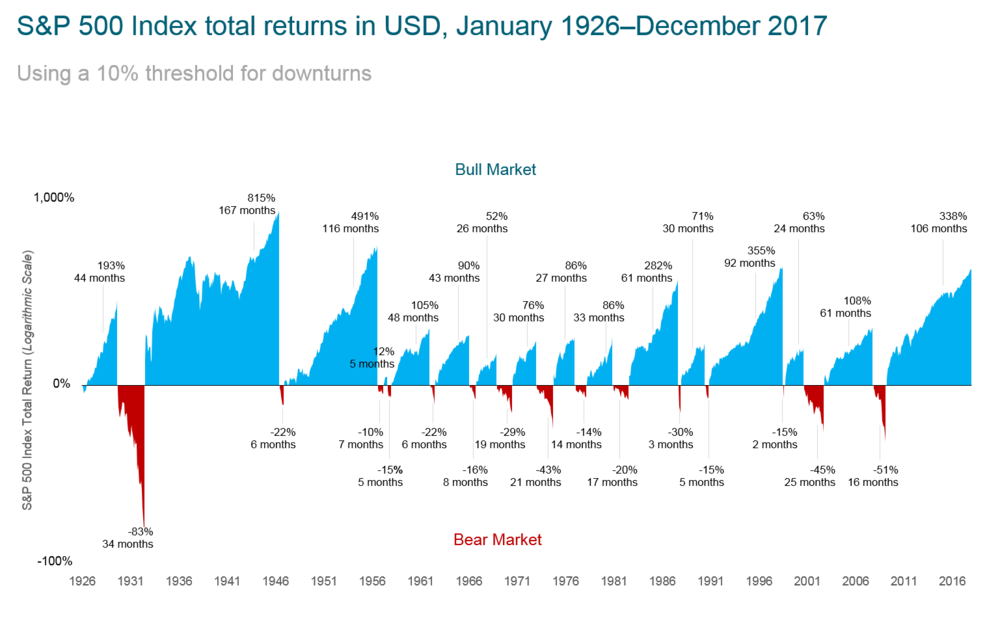
By contrast, a bear market is one that is in decline, typically having fallen 20% or more from recent highs. Share prices are continuously dropping, resulting in a downward trend that investors believe will continue, which, in turn, perpetuates the downward spiral.

During a bear market, the economy will typically slow down and unemployment will rise as companies begin laying off workers.
How does this affect investor behaviour?
Because the market performance is impacted and determined by how individuals perceive that performance, investor psychology and sentiment affect whether the market will rise or fall. Stock market performance and investor psychology are mutually dependent. In a bull market, investors willingly participate in the hope of obtaining a profit.

During a bear market, market sentiment is negative as investors are beginning to move their money out of equities and into fixed-income securities, as they wait for a positive move in the stock market. This is not always the best move – following the crowd is not always in our best interest.

For those who are able to ride the market out, in theory, will benefit in the long run. The graph above shows us that in the last 90 years, the markets have grown more than they have fallen.

How does this affect the economy?
Because the businesses whose stocks are trading on the exchanges are participants in the greater economy, the stock market and the economy are strongly linked.

A bear market is associated with a weak economy as most businesses are unable to record huge profits because consumers are not spending nearly enough. This decline in profits, of course, directly affects the way the market values stocks.

In a bull market, the reverse occurs, as people have more money to spend and are willing to spend it, which, in turn, drives and strengthens the economy.

The Bottom Line
Both bear and bull markets will have a large influence on your investments, so it’s a good idea to take some time to determine what the market is doing when making an investment decision. Having the input from your financial adviser is crucial at this point – but neither market situation is better or worse than the other as both have opportunities and threats to your investment potential.

Remember that over the long term, the stock market has always posted a positive return.

Click here for the article on Investopedia

Why have the markets taken a knock?

In a nutshell, the markets are driven by business activity which is supported by investor confidence. When businesses have investors, they can grow and create more value, which in turn encourages more investors. When businesses can’t run normally (like in the case of a global pandemic), investors fear they will lose money and pull out their investments or stop supplying more cash – which hits the businesses even harder.

The interconnected world we live in means we are all affected by movements in other countries. Trade shutdowns and lockdowns on the other side of the world will affect everyone here too.

Whether it’s directly linked to investments, supply of goods to trade, or indirectly through the price of petrol for our cars or the supply and cost of goods in the grocery stores. Some of us will be fortunate not to lose our jobs, but our economy will shoulder the burden of those who do.

Events that knock global markets are often referred to as Black Swan events.

The Black Swan theory describes an event that is unpredictable and which has a significant impact. For example, if we take the effects of COVID-19 (Coronavirus) and add it to an oil war, spice it up with local business confidence being low we have a significant knock to our economy.

The good news is that we’re all in this together. We’re not isolated, which means that we can work together with greater strength and resolve to solve the problems that will stem from a global Black Swan event. We see this in how banks and other large companies step in to assist consumers.

“Recently, the coronavirus pandemic has added uncertainty to global markets. No one can confidently state its impact or for how long it will last. It has already impacted our tourism sector, slowed down economic activity and caused growth forecasts to be slashed. This has led to a large sell-off of riskier emerging market assets reflected in the over 25% drop in the JSE Top 40 index within the last month. The latest global travel bans and the drop in the S&P 500 by over 20% are indicators of the virus’s effect on first-world countries.” 22Seven

When we see words like “economic crash” filling up our Twitter feed, we may rightly begin to worry about our investments.

We have two options: sell now and time our re-entry or wait it out.

The market does recover – this has been proven time and time again over the last 90 years. As it stands, recovery times are, on average, just under two years when in a bear market (watch out for a blog coming soon on bull vs bear markets!).

However, it’s difficult to predict share price movements. This is another reason to not sell investments, as it’s difficult to predict when to buy them back. A good strategy for most would be to continue with monthly capital injections.

(Ideas for this blog come from 22seven)

Understand what you need in your adviser

Here’s the thing about a 20-minute DIY job: it never takes 20 minutes.

Either you don’t have the right tools, or the right skills… or the materials turn out to be too hard, too soft, too big, too small etc.

On the rare occasion, it might take you 20 minutes or less. You might be perfectly suited to it, and have all you need on hand. For most of us – it doesn’t turn out that way.

The same is true for our financial planning. It’s not about relinquishing control, it’s about maintaining a fresh perspective on how you manage your money and making sure it’s being done in the best possible way.

A mentor once said that it’s easy to build a bridge – just pour an excessive amount of cement into the valley where you want to cross. When we think about this ridiculous idea, we realize how important engineers are.

Again – the same applies to accepting the need for a financial adviser, planner or coach. You can spend your money on whatever you want, but is that going to work out well for you? You can choose any risk or investment products you want online, but will those work out well for you?

If your money was cement, and you had to build a bridge to your future self, wouldn’t you want to have plenty of cement to make it across safely without running out of supplies in the first four meters?

A financial adviser will help, but you need to know what kind of adviser will suit you best.

Independent vs tied financial advisors
An independent financial advisor is someone who offers advice on products from multiple service providers. They usually work for themselves or are part of a group of independent financial advisors.

On the other hand, tied financial advisors will only provide advice on products their company offers. They typically have a deeper knowledge of a narrower set of products. There may be convenience or rewards related benefits when dealing with a single provider.

It’s important to identify which type of financial advisor you’re dealing with before signing any contracts with them.

Commission-based vs fee-based rates
Commission-based advisors are paid a commission on the products they sell. They are paid when the investment is made or the insurance policy is taken out and their advice is tightly coupled to the products they sell. However, they don’t charge a fee for meeting you.

Fee-based advisors charge a fee for advising you regardless of whether you purchase a product. There are advisors who operate a hybrid of these two structures and will benefit from both giving advice and selling products.

Fees will have an impact on the value of the investments you make and the insurance premiums you pay. Although they may sound burdensome, they are usually negotiable, so it’s worthwhile having a conversation about.

Don’t wait until you have lots of cement… uh, money.
You don’t need to be wealthy to have a financial advisor – this is a common misconception. You do however need a solid stream of income and a positive commitment towards making your money grow over time.

(Definitions from 22seven)

Financial wellness mindsets for life’s autumn

Autumn is a precious time of year and is perhaps an altogether more positive metaphor for another special time: the tail end of middle age when we are far from elderly, but far from young.

You look up one day and realise that while you were busy building a life with your family, or perhaps pursuing a fulfilling career, the years rolled by more quickly than you thought. There’s still time on the proverbial clock, but you’ve now reached the autumn of life. What can you do to ensure financial stability?

Just like autumn, this age is a time of rich maturity and transformation, pausing to enjoy the comforts of life you’ve stacked up for yourself and settling in for the winter.

The ‘autumn of life’ also, however, requires a completely different financial strategy and mindset. Here, some top tips for navigating your own ‘autumn’:

Hold to a relatively firm budget

By the time you’re in your mid to late fifties, the kids have most likely flown the nest to build futures of their own and if you’re fortunate, you may have already paid off your bond. This newfound financial freedom might tempt you to spend more extravagantly but now more than ever, a level head will be your best asset.

When you’re out with friends, entertain modestly and resist the urge to pick up everyone’s tab for the sake of appearances. At this point, you shouldn’t feel the need to impress those in your social circle.

Another important thing to bear in mind is that while you’re still an active member of the workforce, you should increase contributions to your retirement fund as much as possible.

Be an adviser to your children, but not an endless safety net

If you have kids, your natural inclination will always be to help them in troubled times, no matter how old they get. While admirable, your parental instincts must be balanced with a pragmatic approach to the shifting realities of your own life.

The fact is that very few older parents are in a position to act as an eternal wellspring of material resources and even if you are, the better course of action is to raise children with the strength and independence to stand on their own feet.

Never be afraid to learn something new

If there’s one tip that older professionals should consider taking from their 20-something counterparts, it’s the value of being willing to adapt to change and acquire new knowledge. With the plethora of reliable educational resources available online (often at low or zero cost), self-driven learning has never been easier.

Retirement expectations are changing fast too. With a combination of well-earned experience and some freshly developed skills, you might even be able to bolster that retirement fund with an entrepreneurial endeavour that only begins in your sixties.

Offshore investing and the new expat tax

As of 1 March 2020, an amendment to the South African Income Tax Act will have definite ramifications on the lives of South Africans living and working abroad.

Now that this infamous ‘expat tax’ is in effect, SA expats are now obligated to pay up to 45% of their foreign income to the taxman when it exceeds R1 million per annum, which includes any fringe benefits provided as part of the job.

But what about investors? How does ‘expat tax’ change your investment strategy and how should you approach offshore earnings being taxed from an investment perspective?

Please remember that the following does not constitute financial advice.

Offshore investments and the expat tax

First, the somewhat good news: investment income is still considered passive income and, if you are residing in South Africa and a citizen but have offshore investments, dividends and the like will be taxed just as they always have been and not under the new ‘expat tax’. Same goes for rental property owned overseas, shareholder earnings and so on. As long as it’s passive, you should be fine.

Active income and expat tax

But what if you do work overseas, at least some of the time? Even for those with stable and reliable employment, maintaining one’s life in a second city can be costly.

In this situation, your choices are frustratingly few. You can either return to SA, find an offshore structure in which to invest those earnings, or formalise the process of financial emigration. Each of these options comes with significant consequences.

For many expats, particularly those who have lived elsewhere for an extended period and thereby assimilated into the culture of their host nation, the idea of returning to South Africa and all its social and political instability is not a welcome one.

If you are a skilled professional with good standing in the other country, the concept of financial emigration may best suit your needs. At a very basic level, this is making the official decision to sever your connection with South Africa and surrender your status as an ordinary resident. Beware though, because doing so will impose strict limitations on what you can do with locally remaining assets, impede your ability to acquire more in the future, as well as having serious implications on capital gains tax. Furthermore, depending on how and when you choose to relinquish citizenship, your actions may be assessed with a distrustful attitude. Especially now, after 1 March.

Two of the main reasons for choosing this route are if you are certain you have no intention of returning to South Africa, or if you stand to receive a substantial inheritance in the years ahead – R10 million or more. Once you’re no longer an ordinary resident, any inheritance should potentially be paid to you directly in the foreign jurisdiction, without the need for approval from the South African Reserve Bank or clearance from the South African Revenue Service, both of which apply to South African citizens.

Investment solutions

Other ways to protect your foreign earnings would be to establish a formally recognised company in a tax-friendly location, through which to invoice your employer, though taking such a path would mean you’ll need to pay very close attention to the specific conditions and requirements, in order to comply with international law.

Finally, it could be an option to put those earnings into an offshore investment platform somewhere the tax codes aren’t so harsh, thereby limiting your exposure to penalties and estate duty. Whichever option you pick, none will be particularly easy or stress-free, but decisions must be made to ensure you have legally compliant structures in place to protect your current lifestyle and future prospects.

Ultimately, the laws surrounding taxation are a quagmire at the best of times, and become infinitely more complex when different countries’ laws are at play simultaneously.

The ‘expat tax’ situation highlights the need for sound professional financial advice within a good understanding of South African offshore investment vehicles, fiduciary laws of the countries in which you earn and what your particular financial goals and needs are.

The NHI: What we know so far

South Africa has just had its annual Budget Speech, with one of the many controversial topics not addressed being the National Health Insurance scheme. Yet President Ramaphosa stated very recently that he expects it to be fully rolled out within the next five years.

The NHI was initially to kick off on 1 March 2020 but is currently years away from full implementation, with much still unknown about how NHI will actually work.

So, what do we know? Here’s a list of answers to common questions about the NHI in order to keep you up-to-date with the latest facts.

What happens to my medical aid and insurance when NHI kicks in?

Much has been made of the fact that medical aids may not legally cover anything the NHI will cover. While this doesn’t necessarily mean the end of medical aid schemes in South Africa, it’s a major disruption and medical plans will be significantly restructured or made obsolete.

What about other insurance? Currently, there isn’t any obstacle for insurers, particularly life insurers, covering what they already do. So, financial protection in the event of a temporary or permanent disability, a critical illness like cancer or a fatal accident or condition will most likely all still be covered in exactly the same way.

Should I even bother with insurance then?

Government has insisted that NHI will be “comprehensive”, but no list of services has yet been released and, with “comprehensive” being very much open for interpretation, this is unclear. So, at this stage it’s really too early to tell.

Sophisticated treatments such as oncological treatment for cancer patients would likely not be covered (again – this is not confirmed). This is where life insurers would step in, especially as medical aid schemes may have their hands tied by the NHI. A dread disease benefit, for example, would pay out 100% for something like cancer or a heart attack to pay for or contribute towards that person’s oncology bills and the other financial strains associated with critical illness.

Will I have to go to a government hospital under NHI?

In theory, the aim of NHI is exactly the opposite of this – for those who have been forced to make do with government hospital experiences to be able to now access private medical healthcare practitioners.

In practise, all South African citizens will be required to register at their nearest NHI-accredited primary healthcare facility and be limited to primary healthcare only at that facility. Whether those will be private clinics like Netcare, your usual GP or state hospitals is currently anyone’s guess.

Going anywhere other than this has to be officially recommended by the doctor or medical staff at that registered facility and approved – which may make seeing specialists like orthodontists, gynaecologists, oncologists and paediatricians a lengthy red tape experience.

When is NHI coming into effect?

No one knows when exactly NHI will come in. It is currently expected to be fully operational as soon as 2022. This is still the target date for more vulnerable citizens like the elderly, disabled and children.

The National Health Insurance Bill states that the NHI fund must be in action some time in 2026. It remains to be seen whether this will be the case, though. Many medical aid schemes, like Discovery for example, maintain that NHI will take far longer to come into full effect.

How much will I be taxed for NHI?

Again, we don’t yet know. The biggest portion of funding is likely to come from an increase in personal income tax. As medical aid contributions come to many via their jobs, payroll taxes for employees will also likely foot the bill. On the government’s side, what Treasury currently allocates to provinces through provincial equitable shares and conditional grants under the system as it stands now will probably be reallocated to the NHI Fund.

There may also be another bitter tax pill to swallow where the NHI is concerned: no medical aid tax deductions.

While much is still murky when it comes to NHI, many experts believe that the insured population, who are already members of comprehensive medical schemes, will keep paying private medical aid fees anyway to avoid the long waiting lists, queues and restrictions on specialists and GP visits likely to manifest once the NHI does. However, they won’t get any tax deductions for it anymore.

So, the average policyholder will likely pay twice – for NHI and medical aid – and get none of the money back they currently are.

Can I choose my participation in National Health Insurance?

Unfortunately not. All South African citizens and permanent residents will be mandatorily enrolled from the state’s side once NHI comes into effect. There will be no choice involved.

At present, as much is unknown about National Health Insurance as is known – which is understandably worrying for the average policyholder. All of this is even more reason to pay regular attention to your portfolio.

Does your wealth creation strategy need more love?

February is the month of love, but it’s also the first real month of the year for most of us, once we’ve got back into our routines and come back to grips with life after the holidays in January. As a result, you may be thinking of how to get your 2020 goals going, especially your financial goals, rather than romance.

However, there is a way to think of both. In honour of the month of love, we’ve made a list of things to ask yourself on behalf of your investment strategy, based on some of psychologists and marriage counsellors’ favourite questions for couples to ask each other.

Do we want the same things?

What do you truly want out of your relationship with your money? What’s your ultimate goal – to retire well? Or be protected from unemployment? To have your loved ones protected after you’re gone?

The reason to ask yourself this is to lead on to another question: do you have the right products for your investment strategy? If the discretionary fund you’re in is geared towards offshore investing with the ultimate purpose of retirement, yet you want income coming from that, you and the products you have may be at odds. This is why it’s helpful to review your portfolio regularly and make it’s still working well for you.

Are we spending enough time together?

The key to making any relationship work is spending quality time together, and the same goes for your investments. Life tends to happen and, often, the whole year can go by without most of us revisiting the status update on our investments. In general, it’s a good idea to revisit your investment strategy and see how investments, annuities and the like are all doing between two and four times a year, or whenever a major life event like buying property, marriage, the birth of a child or divorce occurs.

 What do you really need from me to make your dreams come true?

Some of us can be tempted to treat our financial goals like a wish list or creative writing exercise, summoning up whatever dreams our hearts desire and then setting aside whatever funds, effort and time we deem they have available, without stopping to really calculate whether it’s a realistic picture. Again, this is where it helps to have a financial adviser in your court!

It’s important to frame a realistic and achievable investment strategy, armed with information and ideas you need to really achieve those goals.

What are my habits that you do not like which I should stop?

We all have bad money habits. All of us.

There may be some that are hurting your money more than others and, when stopped or cut back, will lead to a blossoming of your relationship. Not sure what your bad habits are? A good place to start is with our piece this month – ‘What’s the state of your budget?’

Ultimately, a wealth creation strategy is a relationship between you and your money. You get good relationships, ones that go the distance, and you get bad ones. And just like any relationship, it takes hard work and honesty.

What you need to know about the new ‘expat tax’

One of the hardest aspects of working with tax and tax law is that the rules change slightly every year – making it tricky dice to roll without an expert on your team.

There will be a new law soon that legislates how much tax you as a South African must pay on money you do not earn in and from South Africa.

On 1 March, the new section 10(1)(o)(ii) of the Income Tax Act (known as ‘expat tax’) comes in after an extension period granted by the government previously. The section was controversial in that the government said in 2017 that the Taxation Laws Amendment Bill would be done away with completely and all money earned overseas by South Africans would be taxed by the South African government.

Government has backtracked slightly – as of 1 March, 2020, any money over and above R1 million earned by a South African outside of South Africa is subject to South African tax under the new changes.

Here is an overview of how the expat tax could impact you:

Only for South African residents

If you are domiciled in South Africa and are a ‘tax resident’ in the eyes of SARS, then this will apply to you. It also applies to those who have been living in SA for any period in the past year before 1 March 2020. This becomes null and void if you’ve been out of SA for 330 consecutive days, SARS lays it all out here.

Types of income taxed

These vary, but include any salary, wages and forms of remuneration for active employment. Commission, leave pay, bonuses, travel allowances and reimbursements and anything else like that which is earned outside of South Africa will be taxed after the R1m mark.

What will not be taxed

Passive forms of income, like rent earned from a property owned overseas, investment dividends or shareholder amounts for companies outside of South Africa, will not be taxed. This section of the Income Tax Act is all about income received for work.

Only for individuals

The ‘expat tax’ is not for businesses, trust funds, NGOs… only for individuals. In other words, anyone that can earn a salary. Certain independent contractors will also not fall under this tax, but not so for anyone working for a foreign company. If you’re in South Africa or a ‘tax resident’ in the eyes of SARS, it doesn’t matter where your company is domiciled.

How much will you be taxed?

SARS says that everything above R1 million will apply for “the normal tax tables for that particular year of assessment.”

The rates have not changed since last year, so ostensibly that means 41% for those earning R1 million nett income annually and over and the maximum 45% for those earning R1.5 million annually, and over. This means that the maximum anyone will get taxed is 45% – including those getting taxed by the country they are earning in. So, if a South African working for a UK company gets taxed 20 percent on that income by the UK, South Africa will only tax them 25% maximum. 

If you earn money from anyone outside of South Africa and feel this may apply to you, you may want to book a chat so that we can work through the possible implications. 

Gross earnings can add up faster than many realise, especially with the exchange rate being what it is. Ultimately, it’s worth being clued up on anything that affects your money and wealth creation journey.

What’s the state of your budget?

Each year we are presented with our president’s State of the Nation address and the finance minister’s budget speech around the same time. The SONA is closely linked to how money is spent; it’s a powerful reminder for us to consider the close link between our lives and our budgets!

Good finances begin and end with good budgeting – when you have a good budget and stick to it, you’re often 90 percent of the way to wherever you want your money to get you. But what is it about budgets that make it so hard to stick to them?

Failed state 1: The fantasy budget

This may sound familiar: you decide to work out your new budget, so you write down your income, your monthly expenses are guesstimated and some vague savings goals like ‘get out of debt this year’ or ‘save R4000 for retirement every month’ are set.

What’s wrong with this picture?

It’s not specific enough.

Many of us don’t work with an accurate measure of what we are spending day to day. We tell ourselves we spend R250 on our morning cup of coffee at work because that’s an amount we’re subconsciously okay with, when it may be closer to R550 per month. We tell ourselves we’ll ‘get out of debt’ but haven’t tracked exactly how much is owed on the credit card, or how much our interest is costing us.

A budget based on speculation is a fantasy budget.

A better budget: Get real about tracking

There’s a reason why almost every diet out there insists that you start by tracking exactly what you eat – reality is hard, but it works.

To start creating a budget, take a look at your bank statements for the last 3 months at least to determine your real expenses and the exact amount you make monthly. It’s also worth looking at the exact amount of debt outstanding on anything like credit cards or store accounts and, if you have savings goals, the exact amount you’ve saved so far.

Not only will you have a clear picture for the first time, you’ll also be inspired by the dose of reality to keep saving and keep an eye on those expenses.

Failed state 2: The too-tight budget

A super realistic budget shaped by the step above is great, but can sometimes lead to the second most common error in budgeting: a too-tight budget.

This may seem contradictory to you, but it is very important not to account for each and every cent with no flexibility. An okay budget works with exactly what you get and spend in your real life, right now. A good budget realises that life is what happens when you’re making other plans.

If you have no leeway in your budget for emergency expenses, you’re going to struggle to stick to your budget. Emergencies happen, spontaneous purchases happen and sometimes things cost more than even a carefully-planned budget can account for.

A better budget: Set up your own emergency fund

Everyone has sudden expenses, everyone has emergencies. Therefore, everyone can benefit from an emergency fund.

Whatever you can save to guard against these surprises is good, but a general rule of thumb to aim for is three months’ salary tucked away, which will cover you for many unforeseen, unfortunate events. Also, don’t undervalue the importance of insurance for your household items, income and movable assets – not just for your property and car.

Failed state 3:  The emotional budget

You’ve set up your budget and are ready to go, but are you looking at your expenses through objective eyes? Many people classify wants as needs, when in fact they could spend less on eating out, cellphone upgrades, new shoes or the work cafeteria.

Another instance of being emotional with budgeting is when we are unrealistic about how much we can save for certain goals. If our savings goals are unrealistic, we’ll struggle to achieve them and lose precious momentum we need to keep at it. 

Saving is like brushing your teeth – it’s the everyday habit that makes it effective, not a once-off effort.

A better budget: Cut back what you can

Be accurate about what you spend, then evaluate what you can do to cut that down – you’d be amazed at how small amounts add up.

Can’t see your blind spots? Give your budget to someone you trust. They may be able to see with fresh eyes and say: ‘do you really need a new car every year or a bagel from the canteen every day?’

Failed state 4: The solo budget

No man is an island, and very few budgets are either. If you’re married and/or have kids or are living with someone else, you need to take them into account. Why? Because they may well have their own budget ideas that could clash with yours, or you can be assuming something on their part incorrectly. Just because it’s your spouse who always picks up the dry cleaning doesn’t mean that they’ve got it on their budget. And they may well have decided on an aggressive savings plan you know nothing of. It helps to check.

A better budget: Talk the talk

Sit down together and compare budgets. Also, this could be a great opportunity to plan together for a shared incentive, like a holiday. If you have kids, inviting them into the budget conversation can be invaluable education for them too.

Global macro trends for SA investors to watch in 2020

Every investor has their own unique style when it comes to the rigorous decision-making process that goes into what to include in their portfolio and how to weight it. January, with the fresh perspective that comes from a break and a new financial year pending, is often the ideal time to take a look at investment decisions from a new angle.

One of the most useful ways to do that is the big picture look at trends affecting investing on a global scale.

This ‘seeing the wood for the trees’ approach can help with a far longer-term approach.

Here are some of the macro trends experts are saying will most affect investors in 2020 – and far.

Agitated agriculture

Climate change, the hot and bothered elephant in the room in most macrotrends analyses, continues to affect foresights by experts.

In PwC’s ‘Doing Business in Africa’ report, it was forecast that agricultural productivity throughout the continent could be reduced by as much as a third over the next 60 years due to climate change. This will be under even more pressure due to the fact that numerous experts have estimated the world’s biggest population growth for the next 50 years to unequivocally come from Africa. With less agricultural produce and more mouths to feed, what will happen for investors?

This is in direct contrast to the short view, outlined in the 2017/2018 PwC South Africa Agribusiness Insights Survey, which said that agribusiness drives 65 percent of Africa’s employment, with most bigger agribusiness CEOs forecasting a sunny 10 percent revenue growth for coming years.

To invest in agribusiness or not to? That is the question. It depends largely on an investor’s risk profile.

ESG excellence

One shorter-term upside for all this climate focus will likely be the continuing expansion and sophistication of ESG funds, perhaps into a formidable asset class in their own right. ESG has traditionally been seen as a ‘tree hugging alternative’ fund in SA, but has already seen a marked renaissance in the past six months.

However, the environmental ‘E’ sure to be emphasised with all this talk of climate change is likely to only further the ESG interest and value for savvy investors who are willing to look.

The rise and rise of pharmaceuticals

Less of a problem for the rest of Africa – but still a concern for SA – is the global ongoing trend in ageing populations getting older.

We are living longer, but often not living healthier. This has already led to an absolute boom in the frail care and pharmaceutical industries and this is showing no signs of slowing down. Shareholders of medical aids, established drug companies and private healthcare institutions like Netcare are still likely to be laughing all the way to the bank in 2025.

Tech takings

In October, tech thought-leader Gartner made an uncommon media appearance by announcing the findings of their 2019 CIO Survey and, as a result, their 2019-2020 technology trends, which they presented to government as the mostly likely to benefit public services in the next year or two and what their CIOs should look at investing in.

It provides valuable insights for the average investor too.

Startups specialising in digital identity protection software and ‘XaaS’ companies (software companies providing a generalist ‘anything as a service’ range of offerings through the cloud, paid for via subscription). The survey found that a significant 39 percent of government organisations say they plan to spend the greatest amount of any new funding on cloud services above anything else – which for investors means that this industry is ready to boom.

All of these pose attractive opportunities for the average investor, but remember that the savvy investor doesn’t only look at trends – they invest in what they know with the solid advice of a financial professional who knows what they’re doing.

Here’s to a good 2020!